What would make you reject this AI answer?
The AI Pattern: Right or Wrong?
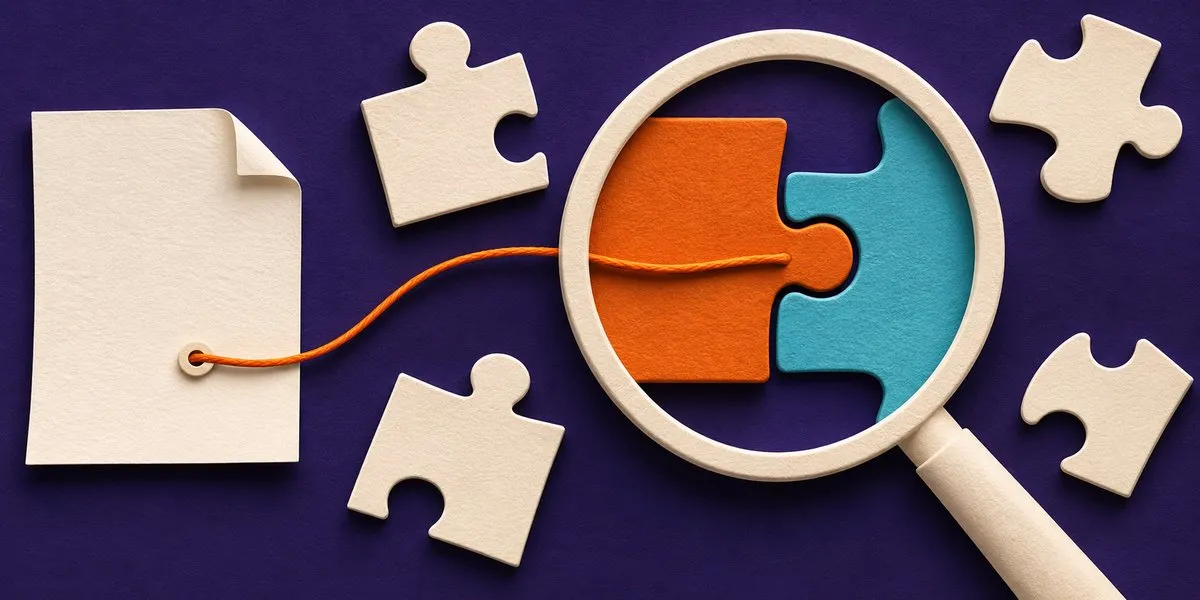
Follow the claim back to the evidence that supports it.
An AI answer can be neatly written, logically arranged, and wrong.
That makes the review harder than checking whether the response sounds sensible. The reviewer needs a way to see what supports the answer and what would change the decision.
NIST's generative AI risk profile describes how these systems can confidently present false information, including fabricated citations. A source name at the bottom of an answer does not tell you whether the source exists or supports the claim.
Source: https://doi.org/10.6028/NIST.AI.600-1
The pattern in the handoff
Consider a hypothetical agent preparing a summary before a client meeting. It finds a proposal and reports that the client approved a new service.
The proposal may be real. The service description may be accurate. The missing piece is evidence that the client accepted it.
If the summary treats the proposal as approval, every later step starts from the wrong assumption.
A more useful handoff would say: “The proposal describes the service. I have not found acceptance. Approval remains unconfirmed.”
That gives the reviewer a specific gap to resolve.
Suppose the reviewer finds a later email saying, “The proposal looks good; can we revisit the start date?” That adds information, but it may leave the timing unresolved. The agent should bring the email into the handoff and identify the open point rather than filling it in.
A useful draft might say: “The client responded positively to the proposal and asked to revisit the start date. Confirm the agreed start date and required acceptance before scheduling the work.”
Now the reviewer has a bounded question. They can check the current agreement and the relevant correspondence, or ask the person responsible. They can also see why the original summary went too far.
Ask for evidence you can follow
For any conclusion that will guide an action, ask the agent to identify the document, its date or version, and the passage that supports the conclusion. Then open the source and check it.
Ask whether the passage supports this exact claim, whether a later document changes it, and whether you have enough evidence for the proposed action. The answer may support a draft while leaving a send or record change premature.
A generated quotation can also be wrong. A working link may lead to the wrong page. A correct passage may describe an earlier version of the arrangement.
The detail matters because the review should follow the claim all the way to its support.
Separate what the source says from what the agent concludes
A source can establish a fact without establishing the proposed next step.
An unsigned proposal describes an offer. An inference that the client probably accepted it remains an inference, however plausible the surrounding conversation may sound.
Ask the agent to label that distinction in plain language. “The document says...” and “This may suggest...” give a reviewer different things to evaluate.
Name the missing evidence
A draft should make uncertainty easy to find. It should identify the unanswered question and the evidence needed to settle it.
If approval is unconfirmed, the next step may be to locate the acceptance or ask the person responsible. That is a practical task. “Please verify everything” leaves the reviewer rebuilding the work.
Give the open question an owner and a next step. For example: “The start date remains unconfirmed. The relationship manager will check the latest correspondence before the schedule is updated.” Once the evidence arrives, record what resolved the question and revise the conclusion. That keeps an old uncertainty from lingering beside a new answer, or a new answer from appearing without any explanation of what changed.
Right or wrong?
Before relying on an AI answer, ask: “What would make me reject this conclusion?”
You might discover that the answer depends on a current agreement, an approved budget, or a source the agent never found. Check that point before the answer becomes an action.
A question for you
Where do AI answers take the longest to verify in your work?
Enter your answer in a reply, without confidential business or client details.
Something funny
The answer had three sources. Unfortunately, they were all very confident about a fourth source nobody could find.
May the Profit be with you,
Joy Francis, CFO and Revenue Capture Architect
